


10 modules, 25h of content
Essential Skills, Confidence, and Business Knowledge to Succeed as a Professional Designer
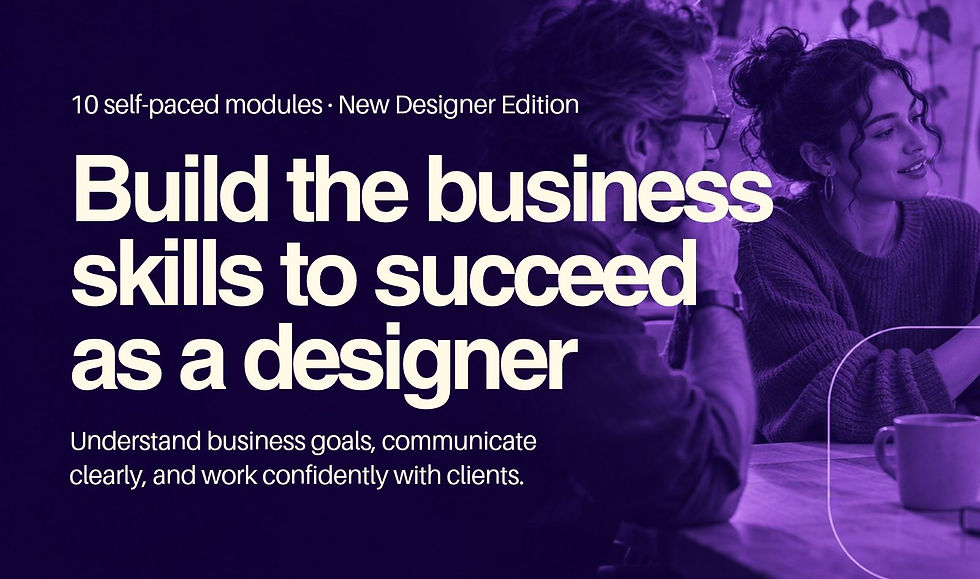
Design For Business: New Designer Edition helps emerging designers bridge the gap between design school and the realities of professional practice. It is for recent graduates and early-career creatives who have learned design craft but want to build the confidence, judgement, and business awareness employers value.
The course teaches that being able to create visual work is only one part of being a design professional. Through 10 self-paced modules, learners develop the strategic thinking, communication skills, and working habits needed to contribute effectively from day one.
They learn how design supports business goals, user needs, and measurable outcomes—not simply aesthetics or personal preference. The curriculum covers collaboration, client relationships, interpreting briefs, user-centred design thinking, data and psychology, process, testing, presentations, and feedback. Participants gain practical frameworks for turning unclear requests into well-defined problems and creating solutions they can explain with logic and evidence.
They also learn how to work confidently with stakeholders, developers, marketers, clients, and other non-design colleagues. By strengthening emotional intelligence and professional communication, learners can receive feedback constructively, manage expectations, and build trust. The result is a more capable, strategic, and employable designer who can connect creativity with real-world impact.
Explain how design creates value by connecting user needs, business goals, and measurable outcomes.
Apply the mindset, communication skills, and professional behaviours expected of a workplace-ready designer.
Interpret and strengthen design briefs to clarify problems, define success, and align stakeholders.
Use user-centred design, research, data, psychology, and accessibility principles to inform design decisions.
Work confidently with clients and cross-functional teams while managing expectations, constraints, and priorities.
Follow a structured design process that supports ideation, efficient iteration, validation, and reduced risk.

Craig Edis
A product leader, digital strategist, and certified design professional with over 20 years of experience, he helps organizations simplify complex processes into accessible digital products. Specializing in UX research, service design, and SaaS modernization, he aligns user needs with business goals to create intuitive digital experiences.